What Modern Brain-Based Therapies Look Like in Practice
- Business
- April 2, 2026
- No Comment
Brain-based therapy is one of those phrases that means different things in different contexts. To a researcher, it might mean any intervention with measurable effects on neural activity. To a clinician, it usually means treatments that work directly on brain function rather than indirectly through behaviour change. To a patient, it tends to mean something specific and unfamiliar: a treatment that uses devices, infusions, or other approaches that look more like medical procedures than like the talk therapy or pill-prescribing that mental health treatment used to mean.
This piece is a practical guide to what modern brain-based therapies actually look like in practice. It covers what the patient experience involves, what the science behind these treatments shows, and how to think about them as part of a larger treatment plan. It is written for patients considering these options and for the family and friends supporting them through that decision.
Transcranial Magnetic Stimulation in Practice
The first major brain-based therapy most patients encounter is transcranial magnetic stimulation. The treatment uses focused magnetic pulses delivered through a coil placed against the scalp to stimulate specific regions of the brain. For depression, the target is typically the dorsolateral prefrontal cortex on the left side of the head. For other indications, different targets and protocols are used.
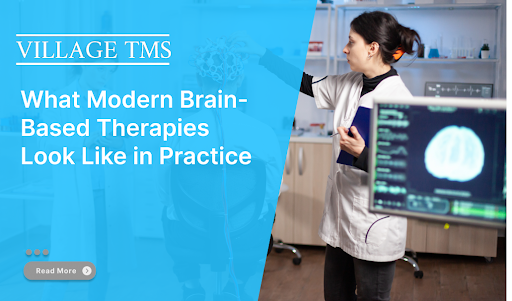
From the patient’s perspective, a TMS session looks like this. The patient sits in a comfortable chair, similar to a dental chair. The clinician positions the coil against the scalp at the targeted location. The treatment runs for somewhere between 20 minutes and 40 minutes, depending on the protocol. During treatment, the patient is fully awake and can talk, listen to music, or read. The most common sensation is a tapping feeling at the treatment site, which patients adapt to within the first few sessions.
After the session, the patient leaves and returns to their normal activities. There is no recovery time, no anaesthesia, and no driving restriction. This is one of the practical advantages of TMS compared to procedures that require sedation. The treatment fits into a workday or weekend without disruption beyond the time spent in the chair.
The Time Commitment Reality
The time commitment for TMS is the practical consideration that derails more patients than the treatment itself. Standard TMS protocols involve five sessions per week for six weeks, totalling around 30 sessions. For patients with predictable schedules, this is manageable. For patients with travel demands, irregular shifts, or significant caregiving responsibilities, fitting in 30 sessions over six weeks can be difficult.
Several adaptations have emerged to address this. Accelerated TMS protocols, sometimes using theta-burst stimulation, deliver multiple sessions per day over a shorter calendar period. These protocols compress treatment into a few weeks at the cost of more intensive daily commitment. They are not appropriate for every patient or every clinic, but they exist for patients whose schedules cannot accommodate the standard six-week course.
Resources like Cost of TMS Therapy lay out the financial implications alongside the time commitment, which is the right way to think about TMS planning. The total commitment includes both. Patients who commit to the time but cannot sustain the cost, or vice versa, end up with truncated courses that work less well.
Ketamine and Esketamine in Practice
Ketamine treatment has a different practical profile than TMS. The standard induction protocol involves a series of treatment sessions, typically delivered over several weeks, followed by a maintenance schedule that varies by patient. The treatment itself can be delivered in several forms.
Esketamine, the FDA-approved nasal spray version, is delivered in a certified clinical setting with monitoring before, during, and after each dose. The patient typically remains at the clinic for around two hours total. Vital signs are checked. The patient sits or reclines comfortably, and most experience the medication’s effects as a calm, slightly altered state of awareness for the duration of monitoring. After the monitoring period, the patient leaves with a designated driver, since they cannot drive for the rest of the day.
Intravenous ketamine has a similar overall structure, with monitoring before, during, and after the infusion, and a no-driving restriction for the rest of the day. According to NIH – Esketamine Research, the clinical experience and monitoring requirements are similar across delivery routes, even though the regulatory pathways differ.
Speed of Response
One of the things that distinguishes ketamine from older antidepressants is the speed of response. Many patients notice mood changes within hours or days of the first treatment. This is not the same as full response, which typically develops over the course of the induction series, but it is meaningfully faster than the four-to-six-week timeline for standard antidepressants.
The speed has practical implications. For patients in acute crisis, faster response can be life-changing. For patients who have spent months or years cycling through medications waiting for results that did not come, the experience of feeling something shift quickly is significant. It is also not universal. Some patients respond more gradually, and some do not respond at all. Setting realistic expectations matters.
TMS, by contrast, tends to show effects more gradually. Patients often notice initial changes around the third week of a six-week course, with full effects emerging over the course of treatment and sometimes continuing to develop for weeks after the course ends. This different time course is one of the factors that influences which treatment fits which patient.
How Brain-Based Therapies Fit with Traditional Treatment
A common misunderstanding is that brain-based therapies replace traditional psychiatric treatment. In practice, they usually complement it. Most patients receiving TMS or ketamine are also taking medication, often participating in therapy, and continuing to address lifestyle factors that support mental health.
The integration matters. A patient on a stable medication regimen who responds well to TMS often maintains gains better with the medication continuing in the background. A patient who completes a ketamine induction series and then stops everything else often loses gains faster than one who maintains foundational treatment. The brain-based therapies are powerful additions to the toolkit, not standalone replacements.
Resources like Village TMS, on TMS treatment options explain how these integrations actually work in practice rather than treating each treatment as an isolated intervention. The integration is where most of the practical clinical work happens.
Side Effects and What to Expect
Brain-based therapies have side effect profiles that patients should understand before starting. For TMS, the most common side effects are mild scalp discomfort during sessions and occasional headaches afterward. The risk of seizure is genuinely rare but real, and patients with certain neurological conditions or with metal in or near the head are not candidates for TMS.
For ketamine and esketamine, the side effect profile is different. The dissociative experience during treatment is part of the medication’s effect and is monitored throughout. Blood pressure can rise during treatment and is checked. Some patients experience nausea or other transient effects. Long-term safety for medical use within standard protocols is well-established, and the protocols at responsible clinics are designed to keep treatment within evidence-based ranges.
Neither treatment is risk-free. Both have generally favourable risk profiles for appropriate patients with appropriate monitoring. The honest conversation about risks should happen before treatment starts.
The Question of Mechanism
Patients sometimes want to understand exactly how these treatments work. The honest answer is that the mechanisms are partially understood and the field is still developing more complete models. TMS is thought to work by modulating activity in cortical regions involved in mood regulation, with downstream effects on connected regions. Ketamine works on glutamate signalling in ways that are not fully characterised but appear to involve rapid changes in synaptic plasticity.
These mechanism descriptions are simplifications. The actual neuroscience involves multiple pathways, time courses, and individual variations that researchers are still mapping out. For practical purposes, what matters is that the treatments produce reliable clinical effects in appropriate patient populations and that the risks are well-characterised. The deeper mechanistic understanding will continue to develop and will refine clinical use over time.
Realistic Outcomes and Maintenance
For appropriate patients, brain-based therapies produce outcomes that conventional treatment did not. Patients who had not responded to multiple antidepressants often respond meaningfully to TMS or ketamine. Some achieve full remission of symptoms. Others achieve substantial improvement that allows them to function more fully than they had before treatment.
Maintenance is part of the picture. Most patients who respond to brain-based therapies need some form of ongoing care to preserve gains. The form varies. Some patients consolidate gains with ongoing medication and need no further direct treatment. Others benefit from periodic TMS or ketamine maintenance sessions. The right approach is individual and is part of what treatment planning needs to address.
Where Brain-Based Therapies Are Heading
The brain-based therapy toolkit is expanding. Newer TMS protocols continue to refine targeting and timing. Various other neurostimulation approaches are at different stages of clinical development. Other glutamate-targeting agents are being studied. Combination protocols that integrate multiple approaches are becoming more sophisticated.
None of this should suggest that the current toolkit is incomplete or that patients should wait for future treatments. The current options are genuinely effective for many patients and represent meaningful clinical advances over what was available a decade ago. The trajectory is encouraging, but the present is already substantially better than it used to be. Patients who would benefit from these treatments now should not delay on the assumption that something better is just around the corner.